
Table of Contents
Summary
- Your windshield provides up to 60% of your cabin’s strength and is essential for proper airbag deployment.
- Generally, if a crack is longer than a credit card or touches the edge of the glass, it must be replaced.
- We use fiber cords instead of metal knives to remove glass, ensuring your car’s paint isn’t scratched and prone to hidden rust.
- Our “V-Bead” glue technique ensures a 100% leak-proof bond with zero air pockets.
- If your car has a safety camera, we re-sync the software so your auto-braking and lane-assist work perfectly.
- You must wait 30–60 minutes before driving to let the adhesive harden enough to survive a crash.
Professional windshield replacement involves removing the damaged glass, preparing the bonding surface, applying urethane adhesive, installing the new windshield, and calibrating ADAS systems. Clearly, it is not a DIY project.
The windshield is an underrated safety component, which provides up to 60% of the cabin’s strength. It prevents the roof from caving in on you and your passengers. The passenger-side airbag fires upward, strikes the windshield, and then bounces back toward the passenger.
The ADAS (Advanced Driver Assistance System) also relies on the windshield to function properly. The camera mounted behind the rearview mirror sees through the windshield to control your automatic emergency braking.
Whether it is a rock chip or a small edge crack, you cannot ignore any damage, as even a minor flaw can compromise these life-saving systems.
When to Replace a Car Windshield?
Many times, a simple fix can prevent structural failure. However, whether you should repair or replace depends on location, depth, and safety risk, not the size of the crack. You must consider professional windshield replacement if:
- There are three or more chips.
- A crack is longer than six inches.
- A crack is touching the outer edge of the glass.
- The damage is directly in your line of sight.
- The inner layer is cracked.
- The damage is near the camera sensors behind your rearview mirror.
- You have a starburst crack.
Phase 1: Pre-Installation & Vehicle Protection
Interior and Exterior Protection
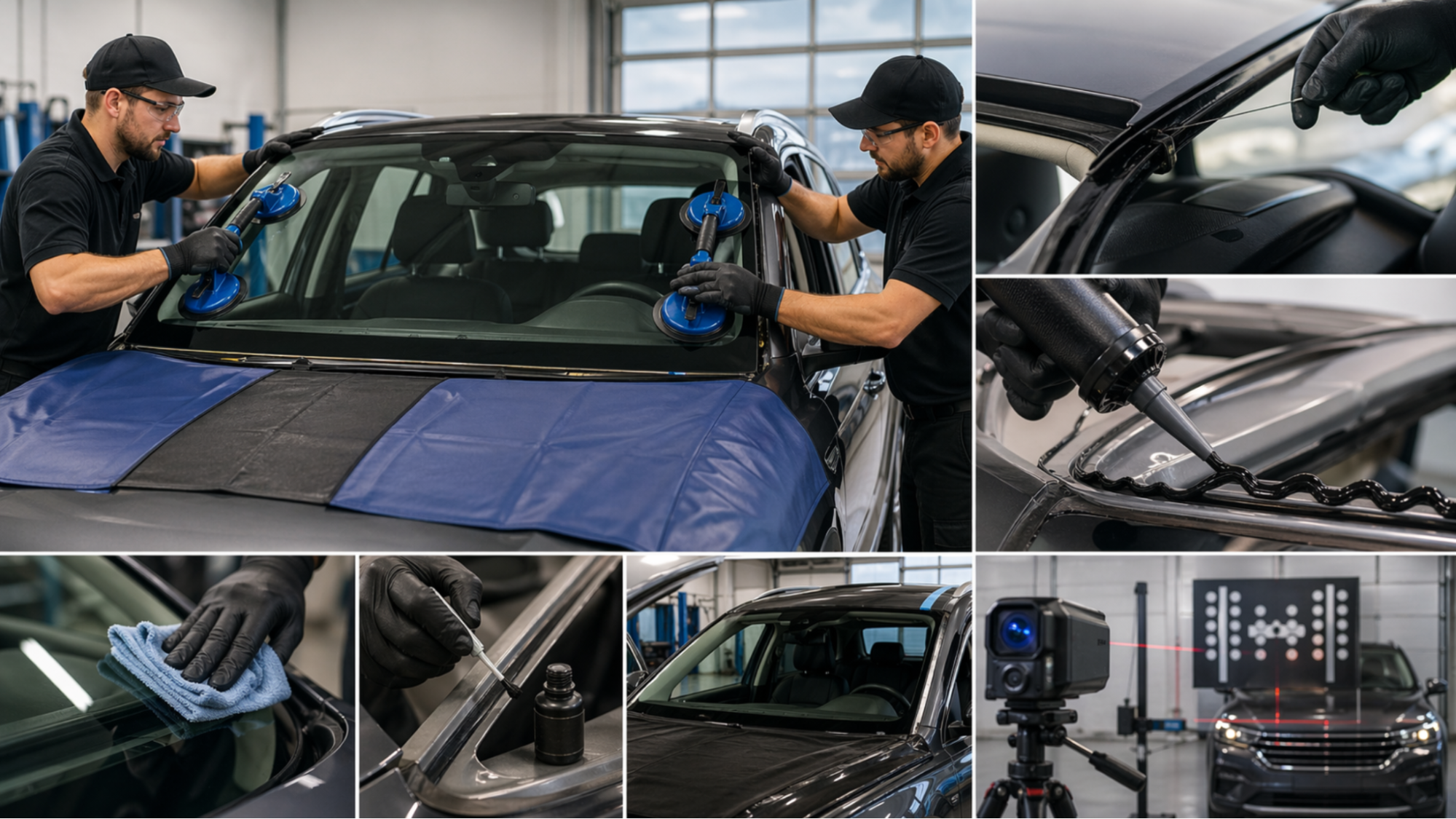
We cover the hood and fenders of your car with heavy-duty mats to prevent any accidental damage to its paint. Tiny fragments of dried glue and glass can fall into the cabin. So, we also protect the dashboard, seats, and floorboards using these mats.
The Technology Audit
We also identify ADAS cameras, rain sensors, antennas, heaters, and every other piece of technology attached to the windshield. It is essential to map out every connection to safely disconnect and preserve these sensitive components, ensuring they function perfectly once transferred to your new windshield. We also document the current condition of your car to ensure complete transparency in our windshield replacement process.
Phase 2: Removing the Old Glass
Advanced Cutting Tools
Urethane is a high-strength automotive adhesive used to bond the windshield to the vehicle frame. That bond must be cut through to remove the old glass. Shops offering low-cost replacements use cold knives, which can scratch the car’s paint with one accidental slip.
We wrap a specialized cord around the perimeter of the glass, which saws through the glue from the inside out. The cord is made of high-strength polyethylene or nylon fibers and removes glass safely without scratching paint or damaging interior trim.
Protecting the Pinchweld
The pinchweld is the metal flange on a vehicle body where the windshield is bonded using urethane adhesive. Any scratch on the pinchweld can lead to rust traps. When the windshield is glued without addressing a scratch on this metal flange, the moisture gets trapped underneath, and the problem stays permanently hidden behind the glass.
Rust creates uneven surfaces, making it difficult for the glue to create a proper seal. This leads to water leaks and wind whistles. Rust also weakens the bond between the glass and the car. A compromised windshield cannot support the roof and operation of the passenger-side airbag.
We make sure that your pinchweld remains scratch-free and protected, ensuring a lifelong bond.
Phase 3: Preparation & Chemical Bonding
The Cleaning Protocol
Windshield manufacturers apply silicone-based release agents to the molds so that the hot glass doesn’t stick. The new windshield must be cleaned, or the glue will stick to the release agent instead of the glass. We thoroughly clean the windshield using industrial glass cleaners so that the adhesive can grab hold of the surface.
Creating an Anchor
We apply a professional-grade primer to both the frame and the new glass to create a porous surface for the glue to lock into. The primer also protects the adhesion from UV rays, as they can dry it out.
High Modulus Urethane
We use urethane, a high-performance adhesive that is engineered to become a part of your car’s structure. It is flexible enough to handle the vibrations and strong enough to keep the roof from collapsing in a rollover accident. We make sure that your windshield provides that 60% cabin strength.
Phase 4: Precision Setting & Sealing
The V-Bead
We use a specialized nozzle to apply the urethane in a V-bead, which is a tall, triangular ridge that stands nearly an inch high. When we press the glass down, the peak of the V collapses outward, squeezing out any air pockets. This results in a 100% consistent seal all the way around the frame.
Setting the Glass
We use heavy-duty suction handles to position the glass with millimeter-level accuracy. When the glass is set improperly, it can cause wind whistles and may also interfere with the rain sensors and ADAS cameras.
Preventing the Pressure Pop
We leave your side windows rolled down about an inch after the job is finished. This is because closing a car door creates a sudden burst of air pressure inside the cabin. That pressure can pop a tiny hole in the seal as the urethane is still wet. The pressure can put the glass out of alignment.
Phase 5: ADAS Calibration
If your car is equipped with Advanced Driver Assistance Systems, it contains a camera mounted behind the rearview mirror. Advanced Driver Assistance Systems (ADAS) are safety features like lane assist and automatic braking that rely on windshield-mounted cameras. If the new windshield or the camera is off by just 1 degree, the car might think the lane line is three feet to the right of where it actually is.
We use the following two methods to sync the software of your car:
1. Static Calibration
We use specialized targets and lasers to aim the camera while the car is parked.
2. Dynamic Calibration
We take the car for a choreographed test drive, allowing the camera to learn the road and sync with its environment.
Phase 6: Quality Control
Before we hand back your keys, we make sure that everything—from wipers to your safety sensors—functions as expected. We verify:
- Rain sensors to detect moisture.
- Auto-dimming mirrors function properly.
- Wipers sweep correctly without hitting the new molding.
Keep in mind that the glass takes 30–60 minutes to set before driving.
Conclusion
No windshield damage can be ignored, and not all damages can be repaired. It is not only unsafe but also illegal to drive a car with a damaged windshield, as the structural safety of the cabin is compromised the moment the glass or its bond is weakened.
916 Auto Glass is a trusted name for professional windshield replacement in Sacramento County, El Dorado County, Placer County, and surrounding areas.
Get a quote now!
Frequently Asked Questions
Get it replaced if:
- The crack is longer than a credit card.
- The damage is located directly in your line of sight.
- There is an edge crack.
Replacing a windshield takes 60 to 90 minutes. The glue also takes about 60 to 90 minutes to harden.
You should wait at least 48 hours before going through an automatic high-pressure car wash to prevent water jets from shifting the seal. However, you can gently hand-wash your car after 24 hours.
OEM glass is an identical match to your factory original. We recommend OEM for vehicles with advanced ADAS camera systems to ensure the highest optical clarity.
While DIY kits can work for tiny chips, they often fail to achieve the vacuum seal and resin pressure needed for a permanent fix. If a DIY attempt fails, the resin usually hardens inside the crack, making it impossible for a professional to fix it later.
Similar Post
How Long Does a Windshield Replacement Take? Complete Timeline Explained
Home Table of Contents Quick Answer: The actual installation takes 60 to 90 minutes. Add 30 to 60 minutes for
Benefits of Choosing Mobile Windshield Replacement Services
Home Table of Contents Key Takeaways Mobile windshield replacement brings certified technicians to your home, workplace, or another convenient location.
How Mobile Windshield Repair Services Work (Step-By-Step Guide)
Home Table of Contents Key Takeaways Mobile windshield repair fixes small chips and cracks without requiring you to visit an